
1 Purpose and Scope of the Licensing Policy
1.1 Introduction
The Gambling Act 2005 (the Act) requires every licensing authority to publish a statement of principles that it proposes to apply in exercising its functions under the Act every three years. This policy covers the period 2019 to 2022. Whilst this policy sets out a general approach to making licensing decisions each application will be considered on its own individual merits. In producing this document the Council has had regard to the licensing objectives, the guidance issued by the Gambling Commission and any responses from those consulted on this policy statement.
When exercising most of its functions under the Gambling Act 2005, the licensing authority will have regard to the licensing objectives set out in section 1 of the Act:
- Preventing gambling from being a source of crime or disorder, being associated with crime or disorder or being used to support crime
- Ensuring that gambling is conducted in a fair and open way
- Protecting children and other vulnerable persons from being harmed or exploited by gambling.
1.2 Scope of policy
This policy covers the functions of the licensing authority under the Act which include:
- Responsibility for the licensing of premises where gambling activities are taking place by issuing premises licences
- Issue of provisional statements
- Regulation of members’ clubs and miners’ welfare institutes who wish to undertake certain gaming activities via issuing club gaming permits and club machine permits
- Issue of club machine permits to commercial clubs
- Granting of permits for the use of certain lower stake gaming machines at unlicensed family entertainment centres
- Receiving notifications from alcohol licensed premises for the use of up to two gaming machines
- Issuing licensed premises gaming machine permits for premises licensed to supply alcohol for consumption on the premises where more than two machines are required
- Registering small society lotteries below prescribed thresholds
- Issuing permits for prize gaming
- Receiving temporary use notices
- Receiving occasional use notices
- Providing information to the Gambling Commission on licences issued
- Maintaining registers of permits and licences issued
The Council does not licence large society lotteries, remote gambling through websites or the National Lottery. These are regulated by the Gambling Commission.
Nothing in this policy will:
- Override the right of a person to make an application and have it considered on its merits
- Override the right of any person to make representations on an application or seek review of a licence where provided for under the Gambling Act 2005.
1.3 Duration and Review
This policy takes effect on 10 July and will remain in force until 30th January 2022. During this time the policy will be subject to regular review and will be updated and modified as necessary to take into account amongst other things changes in licensing legislation.
1.4 Other regulatory regimes
Gambling premises will have obligations placed on them by other regulatory regimes for example Health and Safety. The licensing authority intends not to duplicate other legislation or regulatory regimes wherever possible.
1.5 Exchange of Information
Licensing authorities are allowed to exchange information with other persons /bodies for use in the exercise of their functions under the Act. The Gambling Commission can require the Authority to provide specific information if it forms part of our licensing register or we hold it in connection with our licensing functions under the 2005 Act.
We may also exchange information with other persons or bodies listed below for use in the exercise of functions under the Act.
- a) A constable or Police force
- b) An enforcement officer
- c) A licensing authority
- d) HMRC
- e) The First Tier Tribunal
- f) The Secretary of State
The names and addresses of those making representations will normally be shared with the applicant to enable discussions to take place between the parties to resolve or reduce the areas of dispute. Exchanges of information will be conducted in a timely and accurate fashion and confirmed in writing in all cases to form an audit trail.
1.6 Data Protection and Freedom of Information
Blackpool Council will abide by the Data Protection Act and Freedom of Information Act in respect of safeguarding and releasing information or data. Data Protection Act
This act requires that data must be:
- Processed fairly and lawfully
- Obtained and used for lawful and specified purposes
- Adequate and relevant for those purposes
- Accurate and where necessary kept up to date
- Kept only for as long as necessary
- Accessible to the data subject
- Kept securely
In this context of the Gambling Act this means that Blackpool Council will only retain information that relates to the processing of applications for licences, permits, permissions and representations. This information will only be retained for the period of time it is needed for processing.
Applications and representations are documents which are in the public domain and are therefore available on request and may be published on the website as part of the information supplied if a hearing is arranged, or on the public register.
Information will also be shared with other regulators or persons if this is prescribed by the Secretary of State.
Freedom of Information Act
The Freedom of Information Act allows anyone to request access to information. These requests are normally made in writing either by email or letter. In certain circumstances a fee may be required or we may ask for more specific information. Requests will be dealt with within 20 working days and the information will be released if possible. If it is not possible to release the information an explanation will be provided together with details of how a complaint can be made to the Information Commissioner. The information will be released in the format requested unless it is in the public interest not to do so.
1.7 Responsible Authorities
A full list of responsible authorities designated under the Act and their up to date contact details can be found in our guidance notes to making an application available on the Council’s website www.blackpool.gov.uk
The licensing authority is required to designate in writing a body that is competent to advise it about the protection of children from harm. In making this decision the following principles have been applied:
- The competency of the body to advise the authority
- The need for the body to be responsible for an area covering the whole of the licensing authority’s area
- The need for the body to be answerable to democratically elected persons rather than any particular invested interest group
The licensing authority designates Blackpool Council’s Children’s Service for this purpose.
1.8 Interested Parties
Interested parties can make representations about licensing applications or apply for a review of an existing licence. An interested party is defined in the Act as follows:
“…a person is an interested party in relation to a premises licence or in relation to an application for or in respect of a premises if, in the opinion of the licensing authority which issues the licence or to which the application is made, the person lives sufficiently close to the premises to be likely to be affected by the authorised activities, has business interests that might be affected by the authorised activities or represents a person who satisfy paragraphs (a) or (b)”
In determining whether a person lives or has business interests sufficiently close to the premises that they are likely to be affected by the authorised activities, the licensing authority will consider the following factors:
- The size of the premises
- The nature of the premises
- The distance of the premises from the location of the person making the representation
- The potential impact of the premises
- The catchment area of the premises (how far people are likely to travel to visit it); and
- Whether the person making the representation has a business interest in that catchment area that might be affected
Persons representing those living sufficiently close and/or those having business interests could include trade associations, residents’ and tenants’ associations. Business interests will be interpreted broadly to include, for example, partnerships, charities, faith groups and medical practices.
1.9 Representations
Only responsible authorities and interested parties may make representations. Where a representation is made we will encourage negotiations between the parties to resolve of reduce the areas of dispute and/or to agree conditions. To enable such discussions to take place the names and addresses of those making representations will normally be shared with the applicant. Where a representation is made and not withdrawn, a licensing authority must hold a hearing unless it thinks that the representation:
- a) Is frivolous
- b) Is vexatious
- c) Will certainly not influence the authority’s determination of the application
Examples of representations which will not result in a hearing include those made on moral/ethical grounds, a general dislike of gambling, nuisance issues or planning grounds. Similarly representations which focus on demand or competition will not be taken into account.
1.10 Delegations
It is normal practice in routine, uncontested decisions for the Council to authorise a senior officer to deal with the matter on their behalf. In this way the Council can discharge its functions in an efficient manner and avoid delay. The table in Appendix A sets out the delegated functions under the Gambling Act 2005.
2 The Licensing Objectives
The licensing authority is determined that the residents of, and visitors to Blackpool should be provided with high quality well managed venues for betting and gaming, whilst reducing the risk of crime and disorder and protecting children and the vulnerable. For these reasons the licensing authority will expect detailed plans from operators to show how the objectives will be met.
“Preventing gambling from being a source of crime or disorder, being associated with crime or disorder, or being used to support crime”
The Gambling Commission takes a lead role in preventing gambling from being a source of crime by vetting applicants for personal and operator licences. The licensing authority will however look at the location of the proposed premises in terms of this licensing objective. Where an area is known for having high levels of crime or disorder the licensing authority will consider whether the premises are suitable to be located there and whether conditions such as the provision of door supervisors may be required.
There is a distinction between disorder and nuisance. Complaints about nuisance cannot be resolved through the Gambling Act 2005 however it may be possible to address problems of this nature through other types of legislation.
Factors such as whether police assistance was required and how threatening the behaviour was will be considered in determining whether the incident was disorder or nuisance.
“Ensuring that gambling is conducted in a fair and open way”
The licensing authority will not normally be concerned with ensuring that gambling is conducted in a fair and open way as this will ordinarily be addressed by the Gambling Commission through the granting of personal and operating licences.
“Protecting children and other vulnerable persons from being harmed or exploited by gambling”
This can mean preventing children from taking part in or being in close proximity to gambling.
There is no definition of the term “vulnerable person” but this could include people who are gambling beyond their means and people who may not be able to make informed or balanced decisions about gambling due to a mental impairment or to the use of alcohol and/or drugs.
Location – where the licensing authority is satisfied that there is sufficient evidence to demonstrate that the location of the premises would be harmful to the licensing objectives they will use this evidence to inform their decision on whether to grant the licence, grant the licence with conditions or refuse the licence.
Design – where access by children is permitted to all or part of the premises the design should be capable of demonstrating how access by children will be prevented.
Social responsibility – the protection of children and young persons from being harmed or exploited by gambling is of significant concern, the licensing authority would expect to see the list of measures that will be taken to protect children as well as the assistance that would be made available to those with gambling problems.
3 Blackpool Profile
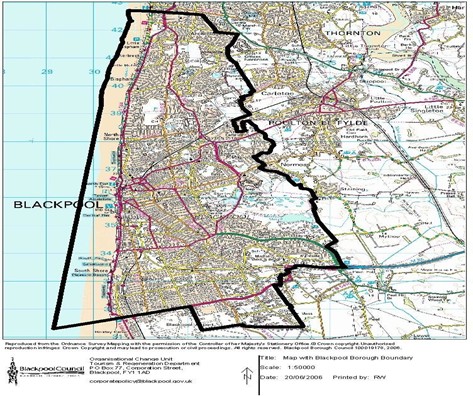
This policy covers the administrative area of Blackpool as detailed below
3.1 Location
Blackpool is a large seaside town located in Lancashire County in North West England. Blackpool is a Unitary Authority and covers an area of 13.46 square miles. Blackpool boundary sits within the urban area stretching along the Fylde Coast, and is one of the most densely populated authorities in the UK outside London. The predominantly rural areas of Wyre and Fylde are located on the northern/ eastern edge and eastern/ southern edge of the Borough boundary respectively.
3.2 Demographics
The population of Blackpooli is estimated at 139,870, with a larger proportion of residents aged 60+ compared to national age structure. Residents are mostly of White British ethnicity. Black and Minority Ethnic groups, including Irish and European residents, are estimated to make up 6 of the population approximately 8500 people, compared with the estimated proportion for England of 20.
| Type | Description | Blackpool | England |
|---|---|---|---|
| Age | 0 to 17 years | 21% | 21% |
| Age | 18 to 24 years | 9% | 9% |
| Age | 25 to 59 years | 45% | 47% |
| Age | 60 plus | 26% | 23$ |
| Ethnicity | White British | 94% | 80% |
| Ethnicity | Withe other eg. European, Irish | 3% | 6% |
| Ethnicity | Mixed/multiple ethnic groups | 1% | 2% |
| Ethnicity | Asian/Asian British | 2% | 8% |
| Ethnicity | Black/African/Caribbean/Black British | 0.2% | 1% |
| Tenure | Owned or Shared Ownership | 62% | 64% |
| Tenure | Social rented | 11% | 18% |
| Tenure | Private rented | 26% | 17% |
4 Premises Licences
4.1 Introduction The Licensing Authority’s primary obligation is to permit the use of premises in so far as it thinks that is:
- In accordance with the relevant codes of practice issued by the Gambling Commission
- In accordance with the guidance issued by the Gambling Commission
- Reasonably consistent with the licensing objectives; and
- In accordance with this Statement of Licensing Policy
Premises licences are subject to the permissions/restrictions set out in the Gambling Act 2005, associated regulations and mandatory and default conditions. Licensing authorities are able to exclude default conditions and attach other conditions if it is believed that they are necessary and proportionate.
Each application will be considered on its own merits. Demand or need for premises of a particular type is not something which the licensing authority can take into account. Other factors that cannot be taken into account are moral/ethical objections, a general dislike of gambling, nuisance issues or the likelihood of planning/building regulation approval.
4.2 Local Risk Assessments
It is a requirement of the Gambling Commission’s Licence Conditions and Codes of Practice (LCCP) that all premises licence holders assess local risks to the licensing objectives posed by the provision of gambling facilities at their premises. Premises licence holders must also have procedures and control measures in place to mitigate these risks. When undertaking a risk assessment the operator must take into account relevant matters identified in this licensing policy. A risk assessment must be completed when applying for a new premises licence and should be reviewed and updated:
- To take account of significant changes in local circumstances, including those identified in this policy
- When there are significant changes at the premises that may affect the mitigation of local risks
- When applying for a variation of the premises licence
As a minimum the risk assessment should include:
- Whether the premises is in an area of deprivation
- Whether the premises is in an area subject to high levels of crime and/or disorder
- The ethnic profile of the area
- The demographics of the area with reference to vulnerable groups
- The location of services for children such as schools, playgrounds, toy shops, leisure centres and other areas where children will gather.
Where concerns exist or new risks emerge, a licence holder may be asked to provide the authority with a copy of their risk assessment setting out the measures they have in place to address specific concerns.
4.3 Local Area Profile
To give assistance to operators completing risk assessments the licensing authority can produce a local area profile to highlight the character and challenges in specific areas. The creation of a profile is dependent on information and knowledge of the local area gathered by partner agencies and other relevant organisations that have the expertise and knowledge of the impact gambling may have. Any local area profile will be published as a separate document. Applicants should give careful consideration to the local area profile when submitting an application. Whilst the licensing authority cannot insist that the local area profile is used when completing a risk assessment an applicant who fails to do so may face additional representations and the expense of a hearing as a result. Existing operators are also expected to update their local risk assessments to take account of any local area profile produced. To assist operators will be informed when a local area profile is published or changed.
4.4 Conditions Premises
licences issued under the Gambling Act 2005 are subject to the mandatory and (unless excluded) default conditions made by the Secretary of State. They are also subject to the Licence Conditions and Codes of Practice issued by the Gambling Commission. Whilst the licensing authority can add additional conditions to a licence this power will only be used where there are clear reasons for doing so. Conditions will only be attached to licences if they are necessary and proportionate. Any condition imposed will be:
- Relevant to the need to make the proposed building suitable as a gambling facility
- Directly related to the premises and the type of licence applied for
- Fairly and reasonably related to the scale and type of the premises; and
- Reasonable in all other respects The licensing authority will avoid imposing conditions which duplicate matters already subject of regulation by the Gambling Commission. Decisions on individual conditions will be made on a case by case basis.
There are conditions which cannot be attached to a premises licence. These are:
- Any condition on the premises licence which makes it impossible for the applicant to comply with an operating licence conditions
- Conditions relating to gaming machine categories, numbers or method of operation
- Conditions which provide that membership of a club or body be required; and
- Conditions relating to stakes, fees, winnings or prizes
4.5 Door Supervisors
In some cases there may be a need for door supervisors in terms of protection of children or preventing the premises from becoming a source of crime. The authority will only impose a condition requiring the use of door supervisors if there is clear evidence from the history of trading at the premises that the premises cannot be adequately supervised from the counter and that door supervision is both necessary and proportionate.
The licensing authority acknowledges the following:
- It cannot make a condition that door supervisors at casinos or bingo premises must be licensed by the Security Industry Authority (SIA). Where a requirement for door supervisors is identified in a casino or bingo hall the licensing authority will determine specific requirements for door supervisors working at these venues on a case by case basis
- For premises other than casinos or bingo halls door the licensing authority may require door supervisors to be registered with the SIA but it will not automatically assume that they need to be; and
- There is no evidence that the operation of betting offices has required door supervisors for the protection of the public.
4.6 Multiple Licences
The licensing authority when considering applications for multiple licences for a building and those relating to a discrete part of a building used for other (non-gambling) purposes will take into account that the third licensing objective seeks to protect children from being harmed by gambling. In practice this means not only preventing them from taking part in gambling, but also that they are not permitted to be in close proximity to gambling. Premises should be configured so that children are not invited to participate in, have accidental access to, or closely observe gambling. Furthermore entrances and exits from parts of a building covered by one or more licences should be separate and identifiable so that the separation of different premises is not compromised and that people do not “drift” into a gambling area. Measures that may be required for such buildings may include the supervision of entrances, segregation of gambling from non-gambling areas frequented by children and the supervision of gaming machines in non-adult specific areas.
The authority will wish to ensure that where category C machines are on offer in premises to which children are admitted:
- All such machines are located in an area of the premises which is separated from the remainder of the premises by a physical barrier which is effective to prevent access other than through a designated entrance
- Only adults are admitted to the area where these machines are located
- Access to the area where the machines are located is supervised
- The area where these machines are located is arranged so that it can be observed by staff or the licence holder; and
- At the entrance to and inside such areas there are prominently displayed notices indicating that access to the area is prohibited to persons under 18 years of age
4.7 Provisional Statements
A provisional statement is a process which allows a developer to discover whether a building they expect to be constructed, altered, to acquire a right to occupy would be granted a premises licence. A provisional statement is not a licence, but it does give an indication that a licence would be granted.
In terms of representations about a premises licence application following the grant of a provisional statement, no further representations from the responsible authorities or interested parties can be taken into account unless they concern matters which could not have been addressed at the provisional statement stage, or they reflect a change in the applicant’s circumstances. In addition, the authority may refuse the premises licence (or grant it on terms different to those attached to the provisional statement) only by reference to matters:
- a) Which could not have been raised by objector at the provisional licence stage; or
- b) Which in the authority’s opinion reflect a change in the operator’s circumstances.
When determining an application for a provisional statement the licensing authority will not have regard to issues relating to planning consent or building regulations, for example the likelihood that planning consent will be granted.
4.8 General standards for all gambling premises
High standards are expected from operators of gambling premises within the Borough to ensure the promotion of the licensing objectives.
The licensing authority will place a high priority on social responsibility. In exercising its statutory powers, the authority will have due regard, where relevant, to the need to:
- Prevent gambling related problems in individuals and groups at risk of gambling addiction
- Promote informed and balanced attitudes, behaviours and policies towards gambling and gamblers by both individuals and by communities; and
- Protect vulnerable groups from gambling related harm
The licensing authority will consider, in relation to any particular premises whether any special considerations apply to the protection of vulnerable persons. Such considerations need to be balanced by the authority’s objective to aim to permit the use of premises for gambling.
Knowledgeable and well-trained staff
The management and customer-facing staff in premises licensed under the Gambling Act are expected to have sufficient knowledge to be able to tackle risks associated with the type of gambling taking place and to know how to promote responsible gambling. Staff should be aware of:
- The importance of social responsibility
- The causes and consequences of problem gambling
- How to identify and communicate with vulnerable persons and how to intervene when a customer may be gambling beyond their means or more than they would like
- How to deal with the exclusion of problem gamblers
- How to refuse entry
- Age verification procedures, how to challenge persons and the need to return stakes/withdraw winnings if an under-age person is found to be gambling
- The information required to be entered into the incident log
Self-exclusion scheme
All premises should operate a self-exclusion scheme. This should include a written agreement drawn up in accordance with the relevant code of practice and trade association advice.
Layout and access
Premises should ensure that appropriate systems and procedures are in place to ensure that:
- Those who have self-excluded are not admitted
- Under 18s are not admitted (where appropriate)
Where under 18s are not permitted on the premises there should be prominent signage at each entrance to this effect and there should be a scheme such as Challenge 21 or 25 in place.
Where people under eighteen years of age are permitted entry to some parts of a premises, for example licensed family entertainment centres, attention should be given to the layout of premises to ensure that under 18s do not gain access to restricted areas. These restricted areas should be suitably monitored.
Where category C or above gaming machines are available in premises to which persons under eighteen years of age are admitted it is expected that:
- All such machines are located in an area of the premises separated from the remainder of the premises by a physical barrier to prevent access other than through a designated entrance
- Only adults will be permitted entry into the area where the machines are located
- Access to the area is supervised by staff of the operator or licence holder
- At the entrance to and inside any such area there are prominently displayed notices indicating that access to the area is prohibited to persons under eighteen years of age.
Where several licences are in place for one premises, or the licence covers only part of the premises, operators must give careful consideration to layout to ensure that children and young people do not gain access to areas used for gambling and are not in close proximity to gambling.
Staff to customer ratio
Sufficient staffing numbers should be in place at all times that the premises are open to the public. The appropriate staffing level for a particular premises should be determined as part of the risk assessment process.
4.9 Specific types of premises
Casinos
Casinos offer the chance for multiple participants to take part in a game competing against the house or to back at different odds to their fellow players. Casinos can also provide equal chance gaming and gaming machines.
Blackpool has a number of casinos which were licensed under the Gaming Act 1968. These now have the benefit of converted casino premises licences.
Bingo Premises
If children are allowed into premises licensed for bingo it is important that they are not allowed to participate in gambling. Where category C or above machines are available on the premises to which children are admitted the licensing authority will ensure that:
- All such machines are located in an area of the premises separate from the remainder of the premises by a physical barrier which is effective to prevent access other than through a designated entrance
- Only adults are admitted to the area where the machines are located
- Access to the area where the machines are located is supervised
- The area where the machines are located is arranged so that it can be observed by staff of the operator or the licence holder; and
- At the entrance to and inside any such area there are prominently displayed notices indicating that access to the area is prohibited to persons under 18.
Adult Gaming Centre
As entry to these premises is age restricted the licensing authority will expect to see sufficient measures to ensure that those under the age of 18 do not have access.
The licensing authority would encourage applicants to voluntarily offer their own measures to promote the licensing objectives including:
- Proof of age scheme
- CCTV
- Supervision of entrances
Licensed Family Entertainment Centre
This type of premises usually offer a range of amusements including Category D gaming machines suitable for all ages together with a separate adult only section for Category C gaming machines.
Licensed family entertainment centres can make available an unlimited number of Category C and D machines. Where Category C or above machines are made available in premises to which children are admitted, the licensing authority must be satisfied that:
- All such machines are located in an area separated from the remainder of the premises by a physical barrier which is effective to prevent access other than through a designated entrance. Rope, floor or similar markings will not be sufficient for this purpose. It is recommended that any division should be a permanent barrier of at least one-metre-high
- Only adults are admitted to where the Category C machines are located
- Access to the area where the machines are located is supervised at all times
- The area where the machines are located is arranged so that it can be observed by staff; and
- At the entrance to and inside any such area there are prominently displayed notices indicating that access to the area is prohibited to persons under 18.
The licensing authority will expect the applicant to show that there are policies and procedures in place to protect children from harm. Harm in this context is not limited to harm from gambling but includes wider child protection considerations.
The policies and procedures will be considered on their merits however the licensing authority would normally expect them to include:
- Appropriate measures and training for staff as regards suspected truant children on the premises
- Measures and training covering how staff would deal with very young unsupervised children being on the premises
- Measures and training covering how staff would deal with children causing perceived problems on or around the premises
- The arrangements for supervision of premises either by staff or the use of CCTV
Tracks
Tracks are sites (including racecourses and dog tracks) where races or other sporting events take place.
All tracks will require a premises licence however, track operators do not require an operating licence from the Gambling Commission as the operator offering betting will hold an operating licence.
Tracks may be subject to one or more premises licence provided each licence relates to a specific area of the track. This may be preferable for any self-contained premises providing off-course betting facilities. The licensing authority will assess each individual case on its merits before deciding if this is necessary.
Children and young people are permitted to enter track areas where facilities for betting are provided although they are still prohibited from entering areas where gaming machines and betting machines (other than Category D machines) are provided.
Betting premises (other than tracks)
Where gaming machines are provided they should be situated in a location where they can be effectively supervised at all times. Such machines should be located as far away from the entrance to the premises as possible to ensure provide staff with the maximum possible opportunity to challenge those suspected of being under18 years of age before they start to play on the machine.
The authority has the power to restrict the number of betting machines, their nature and the circumstances in which they are made available. This would be done by adding a condition to a betting premises licence. Before imposing a condition of this nature consideration will be given to:
- The size of the premises
- The physical layout of the premises
- The number of counter positions available for person-person transactions
- The ability of staff to monitor the use of the machines by vulnerable persons.
Travelling Fairs
Travelling fairs have the right to provide an unlimited number of Category D gaming machines and/or equal chance prize gaming without the need for a permit as long as the gaming amounts to no more than an ancillary amusement at the fair. It is for the licensing authority to decide whether this statutory requirement is met.
4.10 Inspection and Enforcement
It is essential that licensed premises comply with the terms of their licence as well as other requirements of the Gambling Act. Equally important is ensuring that premises not licensed to provide gambling activities are prevented from doing so. Once licensed premises will be monitored to ensure that they are complying with their licence conditions and other requirements of the Act. If unlicensed gambling activities are detected the operator will be dealt with in line with the Council’s Enforcement Policy.
Every effort will be made to ensure compliance through working with licence holders and businesses. Proactive work may include training, giving advice and information, promoting initiatives that educate and inform, and encouraging partners and stakeholders to work together efficiently and effectively to prevent problems occurring.
There will be occasions however where formal enforcement action is necessary to secure compliance. In these situations the following actions will be available:
- Verbal or written advice
- Verbal warning
- Written warning
- Mediation between licence holder and resident
- Simple caution
- Prosecution
- Review
The principles of good regulation and the Regulator’s Code apply to the licensing authority. Inspection and enforcement will be carried out in a transparent, accountable, proportionate and consistent manner. Activities will be targeted on those premises that present a greater risk, have a history of non-compliance with conditions or regulations; or demonstrate poor management practice.
Test purchase operations
The licensing authority conducts test purchase operations to ensure that children are not allowed access to premises or areas where they should not be. The authority will work with operators that have failed a test purchase for the first time to look at the reasons for the failure and to discuss options for achieving compliance in the future by the adoption of best practice, changes to the layout of the premises or the provision of staff training. The effectiveness of these interventions will be tested during a further test purchase operation. Further failures will be treated more seriously with licence review or prosecution being considered.
4.11 Reviews
Interested parties or responsible authorities can make requests for a review of a premises licence. However it is for the licensing authority to decide whether the review is to be carried out. This will be on the basis of:
1 Whether the request for the review is relevant to the matters listed below:
- In accordance with any relevant code of practice issued by the Gambling Commission
- In accordance with any relevant guidance issued by the Gambling Commission
- Reasonably consistent with the licensing objectives; and
- In accordance with the authority’s statement of licensing policy2
2 Whether the request is frivolous or vexatious;
3 Whether the review will certainly not cause the authority to wish to alter, suspend or revoke the licence; or
4 Whether it is substantially the same as previous representations or requests for review.
In appropriate cases the licensing authority can initiate a review.
5 Statement of principles on permits
5.1 General Considerations
It is possible for gaming machines to be made available for use without the need to apply for a premises licence under the Gambling Act 2005. Each application will be considered on its merits. Whilst the authority cannot attach conditions to a permit, applications can be refused if the authority feels that the applicant has not demonstrated how they will meet licensing objective concerns. Applicants for permits will be expected to demonstrate:
- The premises are suitable in terms of its layout and access control to ensure there is suitable supervision of the machines and if appropriate that under 18s and vulnerable persons are excluded
- Customer facing staff are trained in responsible gambling, and how to protect children and vulnerable people from being exploited by gambling
- That there is an appropriate staff to customer ratio to enable adequate supervision of the gambling
5.2 Unlicensed Family Entertainment Centre Gaming Machine Permit
Where a premises does not hold a premises licence but wishes to provide Category D gaming machines it may apply to the licensing authority for this permit. This should not be confused with a licensed family entertainment centre which requires a premises licence because it concerns both Category C and D gaming machines.
The applicant for this type of permit must show that the premises will be wholly or mainly used for making gaming machines available for use.
The licensing authority will expect the applicant to show that there are policies and procedures in place to protect children from harm. Harm in this context is not limited to harm from gambling but includes wider child protection considerations. The suitability of the policies and procedures will be considered on its own merits. Suitable policies and procedures may include:
- A basic criminal record check for applicant and staff
- Staff training programme to include how to deal with:
The licensing authority will also expect applicants to demonstrate:
- A full understanding of the maximum stakes and prizes of the gambling that is permissible in an unlicensed family entertainment centre
- That the applicant has no relevant conviction (as set out in Schedule 7 of the Gambling Act 2005); and
- That staff are trained to have a full understanding of the maximum stakes and prizes
The licensing authority may not attach conditions to this permithowever the application may be refused if the licensing authority is not satisfied that the issues raised above have been addressed in the application.
5.3 Licensed Premises Gaming Machine Permit
There is provision in the Act for premises licensed to sell alcohol for consumption on the premises to automatically have 2 gaming machines of categories C or D by serving the licensing authority with a notification. This automatic authorisation can be removed by the licensing authority if:
- Provision of the machines is not reasonably consistent with the licensing objectives
- The premises are mainly used for gaming; or
- An offence under the Gambling Act 2005 has been committed on the premises
If a premises wishes to have more than 2 machines an application for a licensed premises gaming machine permit would be required. When considering an application the licensing authority will specifically have regard to protection of children and vulnerable persons objective and will expect the applicant to satisfy the licensing authority that sufficient measures will be in place to ensure that under 18s do not have access to adult only machines. Suitable measures may include:
- Adult machines being in sight of the bar
- Adult machines being in sight of staff who will monitor the age of machine users
- Appropriate notices and signage
When considering an application the licensing authority could decide to grant the application with a smaller number of machines and/or a different category of machines than that applied for.
Where an applicant for additional machines can demonstrate compliance with the Gambling Commission Code of Practice on gaming machines, granting of the application will be the normal course as long as the number of machines requested can be shown to be reasonable in relation to the size of the premises.
5.4 Prize Gaming Permit
The licensing authority is concerned that premises with a prize gaming permit will particularly appeal to children and young persons. When considering an application the licensing authority will give significant weight to child protection issues and will need to be satisfied that the granting of a permit will not place children and young persons at risk as a consequence. Suitable policies and procedures may include:
- A basic criminal record check for applicant and staff
- Staff training programme to include how to deal with:
In making its decision the licensing authority does not need to have regard to the licensing objectives but must have regard to any Gambling Commission guidance.
5.5 Club Gaming and Club Machine Permit
Members’ clubs and miners’ welfare institutes (but not commercial clubs) may apply for a club gaming or club machine permit. Both permits entitle the holder to provide up to 3 gaming machines of categories B, C or D. A club gaming permit also authorises equal chance gaming and games of chance.
To grant one of these permits the authority must be satisfied that the requirements of a member’s club are met:
- At least 25 members
- Be established and conducted “wholly or mainly” for purposes other than gaming, except in the case of certain clubs such as Bridge and Whist club which are permitted by regulations
- Be permanent in nature
- Not be established to make commercial profit
- Be controlled by its members
5.6 Temporary Use Notice
A TUN can only be granted for equal chance gaming to the holder of a relevant operating licence.
5.7 Occasional Use Notice
Occasional use notices apply only to tracks which are described as being premises on any part of which a race or other sporting events take place or is intended to take place. When an OUN is in place a licensed betting operator is permitted to conduct betting on those premises. The licensing authority has very little discretion as regards these notices aside from ensuring that the statutory limit of 8 days in a calendar year is not exceeded
Appendix A
| Matter to be dealt with | Full council | Licensing panel | Officer delegation |
|---|---|---|---|
| Three year licensing policy | Yes | No | No |
| Policy not to permit casinos | Yes | No | No |
| Application for a premises licence | No | Where representations have been received and not withdrawn | Where no representations have been received /representations withdrawn |
| Application for variation to a licence | No | Where representations have been received and not withdrawn | Where no representations have been received /representations withdrawn |
| Application for transfer of licence | No | Where representations have been received from the Commission | Where no representations have been received from the Commission |
| Application for a provisional statement | No | Where representations have been received and not withdrawn | Where no representations have been received/representations withdrawn |
| Review of premises licence | No | Yes | No |
| Application for club gaming/club machine permit | No | Where objections have been made and not withdrawn | Where no objections have been made/objections have been withdrawn |
| Cancellation of club gaming/club machine permit | No | Yes | No |
| Applications for other permits | No | No | Yes |
| Cancellation of licensed premises gaming machine permit | No | No | Yes |
| Consideration of a temporary use notice | No | No | Yes |
| Decision to give a counter notice to a TUN | No | Yes | No |
List of persons consulted
- Lancashire Constabulary
- GamCare
- BACTA
- British Home and Holiday Parks Association
- ABB
- Bingo Association
- National Casino Forum
- British Beer and Pub Association
- Gambling premises licence holders
- Public heath